
A Postcard From the Future: What U.S. Distributors Can Learn From Europe’s Artwork Shift

In a previous article we made a case here on Branded Merch Network: artwork preparation is the one layer North America’s merch tech stack never automated. Everything else got faster, quoting, sourcing, ordering, fulfillment, while getting a customer’s logo production-ready still ran on email threads and a designer’s afternoon.
That article ended on a question worth having as a community. This one tries to answer it from an unusual angle: Europe already ran the experiment, and the results are in. Here's a link to the first commentary: Why Artwork Automation Is the Missing Layer in North America's Merch Tech Stack
Why Europe is a useful crystal ball
The forces reshaping U.S. promo right now hit the European market two to three years earlier. Average order values compressed first. Buyers shifted to smaller, more frequent orders first. The squeeze on the art department showed up first. None of that is because Europe is smarter or better run. It’s just further along the same curve the U.S. is now climbing.
That head start is what makes it useful. Not as a set of trends to admire, but as a set of decisions that have already played out, with outcomes you can look at instead of forecast. When you can see how a story ends, you get to skip the expensive middle.

Illustrative: average order values are falling on both continents, with the U.S. trailing Europe by roughly two to three years.
What actually broke
The math is simple and it’s the same on both continents. When margin on a 12-piece order no longer covers a designer touching the file by hand, the manual artwork step stops being a service and starts being a loss.
And most files need a hand. We analyzed 13,773 real customer logo uploads for our 2026 benchmark. About 85% arrived not production-ready. 61% needed vectorization, 79% needed upscaling, and 40% needed the background removed before they could go anywhere near production. Every one of those fixes used to mean a person, a tool, and time. Multiply that across a day of small orders and the art department isn’t a cost center, it’s the bottleneck the whole business waits on.

FastEditor Artwork Automation Benchmark 2026, n = 13,773 logos.
What European distributors did about it
Faced with the same squeeze, the distributors who pulled ahead made one structural change: they moved artwork from something they performed to something the customer completes, live, on the product page.
The customer uploads their logo, sees it on the actual product, adjusts it, and approves. The file that comes out the other side is already vectorized, cleaned, correctly sized and production-ready. For the simple orders, which are the majority of orders, there is no proofing round at all, because there is nothing to correct after the fact. The checks happen up front, automatically, while the customer is still in the flow.
This is the shift the July piece named as request-design-revise becoming upload-generate-approve. Europe didn’t just theorize it. It made it the default.

The operational shift: artwork moves from a service you perform to a step the customer completes.
What changed once they did
Three things, consistently, across the European distributors who made the move.
The small orders became worth taking again. When artwork costs minutes of compute instead of an hour of skilled labor, a 12-piece run goes back to being business you’re glad to have rather than one you quietly hope goes away. That matters more every quarter, because small orders are the fastest-growing and lowest-margin part of the mix.
The art department stopped being the constraint. The team that used to spend its day fixing logos moved to the work that genuinely needs a human eye, the complex decoration, the tricky brand jobs, the accounts worth real attention. Automation handled the median file in about 53 seconds. In production, once files run through the editor, 99.95% go straight to production with no manual intervention.
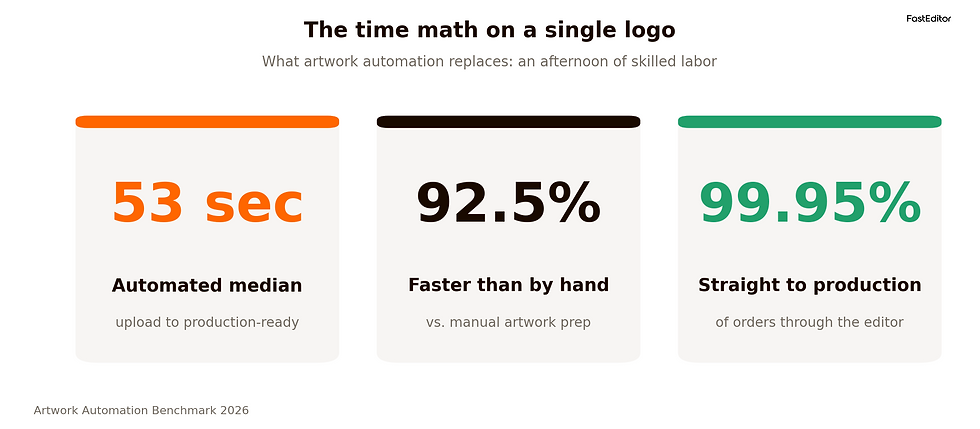
Minutes of compute versus an afternoon of skilled labor.
And speed quietly became a sales weapon. A distributor who can put an accurate, on-product proof in front of a buyer during the meeting wins accounts that a two-day turnaround loses without ever knowing why. That edge compounds on exactly the fast, small, price-sensitive accounts everyone else finds unprofitable to chase.
The objection every distributor raises first
“My customers won’t do their own artwork, and if they do, quality will drop.”
It’s the right question, and Europe answered it. The answer is that the customer isn’t doing artwork. They’re uploading a logo and approving a result. The automation does the artwork, and it does it to a tighter, more consistent standard than a rushed manual fix under deadline, because the same checks run on every single file, every time. The distributors who worried most about quality dropping generally found the opposite: fewer reprints from bad files, fewer “that’s not our blue” conversations, fewer misfires reaching production. Consistency is exactly what a machine is good at.

In practice: the editor flags thin lines that won’t hold up in print, on every file, before the order proceeds.
The second objection, “our products and decoration methods are too specific for automation,” held up less well than people expected too. The catalog and the decoration rules are what the system is configured around. It isn’t generic. It knows the product and the print method before the customer ever uploads.
How to tell if you’re ready
You don’t need to rebuild your stack to start. The practical signals that a distributor is ready for this are boring and reliable: a meaningful share of orders are small and repetitive, your art team is a scheduling bottleneck more often than a creative one, and you’re turning away or slow-walking business because the artwork overhead doesn’t pencil out. If two of those three are true, the European pattern says the manual step is already costing you more than it’s saving.
Why this matters for the U.S. right now
The U.S. is arriving at the same fork Europe hit a few years ago. Order values are sliding, small runs are climbing, and the manual artwork step is starting to cost more than the orders it supports. The pattern that’s already visible across the Atlantic tends to repeat: the distributors who treat artwork automation as infrastructure, not a nice-to-have, keep the small-order business profitable while everyone else slowly prices themselves out of it.
The encouraging part is that you don’t have to run the experiment yourself. It’s been run. The playbook exists, and it’s readable.
Full disclosure, this is the problem we work on. FastEditor builds the API-first artwork automation layer that European distributors, suppliers and decorators have been standardizing on, with 160+ suppliers already connected. But the point of this postcard isn’t the tool, it’s the pattern. Whatever you build or buy, the market is telling the U.S. what it told Europe: the manual artwork step is on its way out, and when you retire it is becoming a competitive decision rather than a technical one.
A conversation worth continuing
If you’re a U.S. distributor feeling the squeeze on small orders, the European experience is the closest thing we have to a preview. We pulled the underlying numbers into an open benchmark, the Artwork Automation Benchmark 2026, if you want to see the data behind the shift.
And if you’re at Branded Merch Networks Automate & Elevate Summit in November, come find us. We’d rather compare notes than pitch.



Comments