
Why Artwork Automation Is the Missing Layer in North America's Merch Tech Stack

North American branded merch is moving faster than it has in a generation. E-commerce is up. Company stores are scaling. Every other corner of retail has trained buyers to expect speed, transparency, and an answer while they're still looking at the screen.
And yet, if you follow an order from “customer sends a logo” to “file goes to production,” you'll find a part of the workflow that hasn't really changed in twenty years: the artwork itself is still done by hand.
That gap is quietly becoming one of the most expensive problems in the industry, and almost no one is treating it as a technology problem.
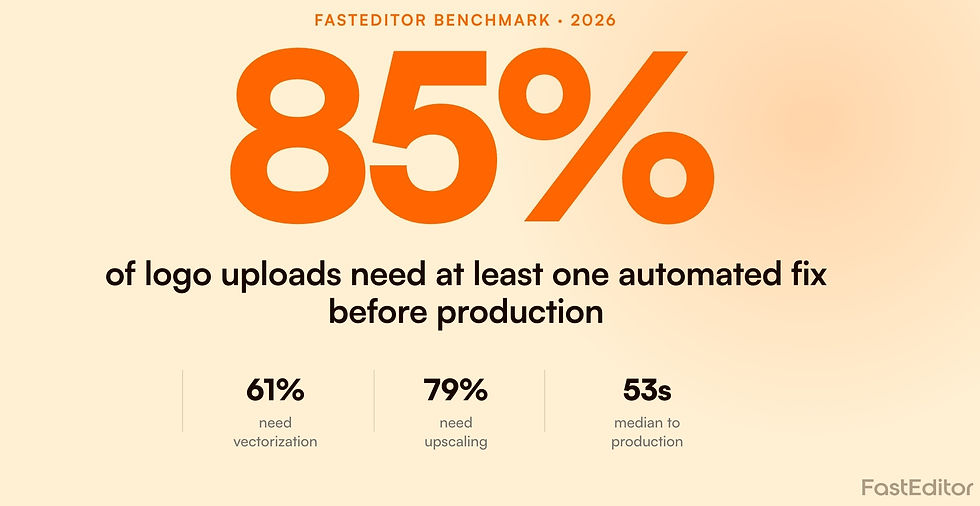
To put a number on it: FastEditor's 2026 Artwork Automation Benchmark, drawn from 13,773 real logo uploads, found that roughly 85% of customer logos arrive not ready for print (61% need vectorization, 79% need upscaling), yet automation takes them from upload to a production-ready file in a median of 53 seconds. The manual alternative is measured in hours or days.
The part of the workflow everyone forgot to automate
Walk into most distributors, decorators, and suppliers, and the front end looks modern. There's a webshop, maybe a company store, a sourcing platform, and a nice product catalog. Then a logo comes in, and the wheels slow down.
Somebody cleans up the file. A designer builds a proof. A DTP team preps the production file. Revisions bounce around over email. Often this happens internally; just as often it's outsourced to a production studio halfway around the world. Either way, it takes time, it costs money, and it depends on a skilled person being available.
Here's the uncomfortable part: there is still no widely adopted technology in this industry that fully automates that work. Plenty of tools handle the front-end visualization, the pretty mockup on the product page. But the actual labor of turning a customer's logo into a print-ready file still happens by hand, on almost every order.
That's the missing layer. Not another design tool. The infrastructure underneath one.
Why is it breaking now, not five years ago
The manual model held up fine when order volumes were smaller, timelines were longer, and margins were healthier. None of those things describes the market in 2026.
Orders are getting smaller and more frequent. Customers want a proof during the same conversation, not the next day. Margins are under pressure from every direction. And the manual artwork step, which barely registered when jobs were big, now eats a painful share of the cost on a small order. When you're processing a 12-piece run, ten minutes of designer time and two email rounds isn't a rounding error. It's the margin.
So the manual approach doesn't just slow things down. It quietly caps how much business a team can take on without adding headcount. That's the real ceiling.
The shift: from requesting design to generating it
The interesting move happening across the industry isn't better design software. It removes the need for design work entirely in standard, repeatable orders.
The old flow is Request → Design → Revise → Approve. The new one is Upload → Generate → Approve. Same outcome, a correct production-ready file, but the human design step in the middle disappears for the everyday jobs that make up most of the volume.
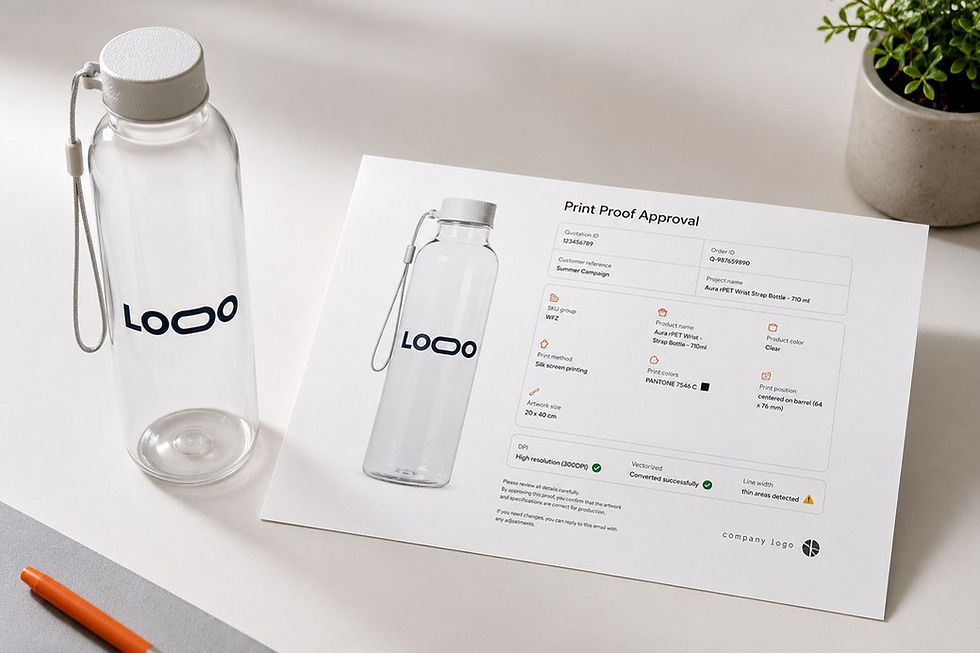
In practice, that looks like this: a logo goes in, gets cleaned and optimized automatically, lands on the product with accurate placement and scale, renders as a proof the customer can actually approve, and comes out the other side as a production file built to the supplier's specs. Seconds, not days. No design skills required from the person doing it.
This is where a category of “artwork automation” tools is starting to form. FastEditor (full disclosure, that's us) is one example of what this layer looks like when it's built as infrastructure rather than a feature. We'll use it here to make the idea concrete, but the point is bigger than any one product: this is a capability the industry has been missing, and a handful of companies are now building it.
What it unlocks for account managers
For distributors and resellers, the day-to-day change is what actually matters, and it shows up first at the account manager level.
The obvious win is instant proofs. An account manager can generate a fully branded print proof in their own company's look and format and send it while the customer is still on the call. No ticket to the design team, no waiting, no “I'll have something for you tomorrow.” In a business where speed of response is often the whole difference between winning and losing a small account, that's not a cosmetic improvement.
The second win is independence. When the everyday proofs no longer route through a designer or an overseas studio, the whole operation gets leaner. Fewer bottlenecks, fewer handoffs, fewer files coming back wrong. In our own numbers across resellers using this approach, that shows up as roughly a 20% lift in conversion and around 80% lower cost per artwork order, but you don't need our figures to feel it. Anyone who's watched a deal cool off while a proof sat in a queue already knows what the delay costs.
Where FastEditor fits, and where the category is going
Because we're using ourselves as the example, it's worth being specific about what this layer actually does, without turning it into a pitch.
Artwork automation, done properly, handles four things end-to-end. It automatically cleans and prepares uploaded artwork, even a low-res logo pulled from someone's phone. It renders the artwork live on the real product, mapped to the print area at the correct scale. It generates a print-ready production file pre-flighted against each supplier's exact specs. And it lets an account manager deliver a branded proof to a customer in seconds. FastEditor is built API-first, so it drops into an existing webshop, ERP, or stack rather than replacing it, but the specific implementation matters less than the principle.
The reason this is worth the industry's attention isn't the feature list. It's that connectivity is where the real leverage lives. When suppliers' products, specs, and visuals are already wired into the automation layer (for us, that's 140+ connected suppliers today), an account manager can go from logo to approved production file without anyone touching a design program. That's the difference between a nice tool and a piece of infrastructure that the whole workflow can lean on.
None of this removes the craft from branded merch. Complex, creative, one-of-a-kind projects will always deserve a designer's hands. What automation removes is the manual repetition on the standard jobs: the 80% of orders that don't need a creative decision, just a correct file, fast.
The strategic read for North American merch
Zoom out, and this isn't really an efficiency story. It's a shift in operating model.
The businesses still handling artwork by hand are running a manual service model: capacity is capped by how many skilled people they can hire, turnaround is bound by a queue, and cost per order stays stubbornly high on exactly the small jobs that are becoming more common. The businesses adopting artwork automation are running a platform model: instant response, cost that scales with software instead of headcount, and a customer experience that feels closer to modern e-commerce than to a design ticketing system.
The biggest bottleneck in this industry was never sourcing, pricing, or even sales. It's artwork. And it's been hiding in plain sight because everyone assumed it was just “how the work gets done.”
The companies that pull ahead in the North American market over the next few years will be the ones that stop treating manual artwork as a fixed cost of doing business and start treating it as a solved problem. When you can go from a customer's logo to an approved, production-ready file in under a minute, you don't just speed up operations; you change how merch gets sold.
That's a conversation worth having as a community. It's exactly the kind of practical, real-world AI adoption the Branded Merch Network has been putting on the table, and artwork is the layer we'd argue is most ready to be automated next.
FastEditor builds API-first artwork automation for the promo, print, and apparel industry. This piece was contributed to the Branded Merch Network as part of the ongoing conversation on practical AI adoption in branded merch. Learn more here: https://www.fasteditor.com/


Comments